Planetary Health
Human health does not exist in isolation. Instead, it very much depends on the health of the planet we live on. Our climate, the richness of our ecosystems, and the quality of our air, water, and soil are all dependent on the complex systems of the world around us. When those systems are disrupted, the consequences can ripple into our daily lives, sometimes in ways we might not expect...including the spread of vectors like ticks and mosquitoes and the diseases they carry.
What Is Planetary Health?
Planetary health is a field that studies the connections between the health of us humans and the health of our natural world around us. The Planetary Health Alliance, a consortium of over 400 universities, NGOs, and research institutes, defines it as:
“The health of human civilisation and the state of the natural systems on which it depends.”
In practice, this means looking at how large-scale environmental changes (like deforestation, biodiversity loss, pollution, and climate change) affect human health outcomes in areas such as nutrition, infectious diseases, mental health, and other non-communicable health problems. It’s a lens that recognises the increasing difficulty of achieving healthy people on an unhealthy planet.
The concept builds on earlier ideas from One Health (which links human, animal, and environmental health), but broadens the scope to include the full Earth system: oceans, atmosphere, ice sheets, and all the living organisms that keep them in balance.
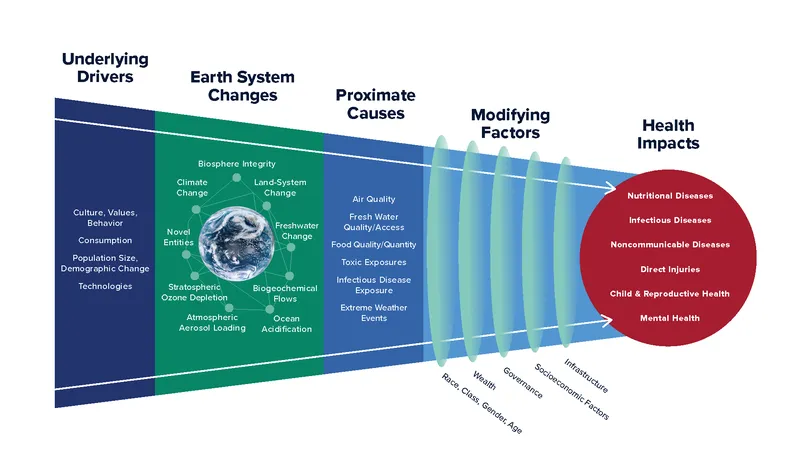
PH-PB-Schematic-July2025.png by Planetary Health Alliance.
How Is Our Planet Changing?
The UK’s climate is already shifting. According to the Met Office, the top ten warmest years since recording began in 1884 are from the last two decades, and "four of the UK’s last five years now appear in the top five warmest years." Milder winters, longer growing seasons, and more frequent heatwaves are increasingly common. Rainfall patterns are also changing, with wetter winters and more intense downpours.
These shifts matter for vector-borne disease because ticks and mosquitoes are ectotherms, or cold-blooded organisms whose activity, development, and survival are highly influenced by temperature and humidity. When the climate changes, so do the conditions that determine where, when, and how many vectors are present and active.
At the same time, land-use change is reshaping habitats. Urbanisation, agricultural intensification, and even rewilding projects all alter the mix of wildlife that vectors feed on, the vegetation they shelter in, and the number and type of contact points between animals, vectors, and people.
Changing Vector Distribution
As the climate warms, vectors are expanding into areas where they were previously absent, or at least rare. For the UK this means:
- Ticks at higher altitudes and further north. Ixodes ricinus, the UK’s most common tick, has been recorded at elevations and latitudes where it was not historically found. Milder winters allow more ticks to survive from one year to the next.
- Longer tick seasons. Questing activity generally gets going once daily maximum temperatures reach around 7 °C, though ticks have been recorded questing below that (see tick ecology). Warmer springs and autumns extend the window of questing activity, increasing the time during which bites can occur.
- Invasive species establishing. Dermacentor reticulatus, previously confined to a handful of coastal sites, has been expanding in south-west England. Warmer conditions may accelerate this process and allow the tick to colonise new areas.
- New mosquito risks. Mosquitoes can respond quickly to warmer, wetter conditions. Species such as Culex modestus are under surveillance because they are linked to wetland habitats and West Nile ecology in Europe. The invasive Asian tiger mosquito (Aedes albopictus) is already established in parts of southern Europe, and continued warming increases the chance of future UK establishment. Just like ticks, warmer, milder winters mean more mosquito species may be able to establish and overwinter in the UK.
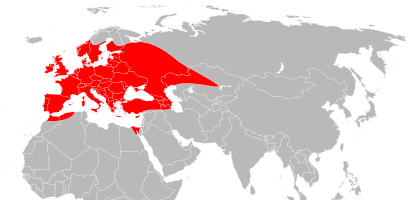
Ixodes ricinus range map by Wikimedia Commons contributors (via Wikimedia Commons).
Changing Disease Risks
Climate and ecosystem change don’t just affect when and where vectors are found; they can also alter the diseases those vectors carry and how well those diseases are transmitted to wildlife, our pets, and ourselves.
In the UK, that means thinking about both ticks and mosquitoes together: tick surveillance remains the main public-health priority, while mosquito monitoring helps identify emerging risk early.
Temperature and pathogen development
Many pathogens go through a development period inside the vector before they can be transmitted to the next host. This is called the extrinsic incubation period (EIP). Higher temperatures typically shorten the EIP, meaning the pathogen matures faster and the vector becomes infectious sooner. For tick-borne pathogens, warmer conditions can also speed up the tick development, leading to faster life-cycle completion and more generations overlapping in a single season, increasing the potential for transmission amongst the tick population.
Host immunity and co-infections
Environmental stressors like heatwaves, poor air quality, and nutritional changes can weaken immune defences in both humans and wildlife. A deer population under nutritional stress, for example, may carry higher pathogen loads, creating a richer source of infection for feeding ticks. In humans, pre-existing health conditions exacerbated by climate change (such as respiratory or cardiovascular illnesses) can make vector-borne infections harder to fight off.
Biodiversity and the “dilution effect”
Healthy, species-rich ecosystems can sometimes reduce zoonotic disease risk. When many different animal species are present, ticks may be more likely to feed on hosts that are poor reservoirs for the pathogen, “diluting” the infection rate in tick populations. Biodiversity loss can remove these buffer species, leaving highly competent reservoir hosts (such as small rodents for Lyme disease) as the dominant food source for vectors, which can increase pathogen transmission.
UK Research Groups & Resources
Several research groups and organisations across the UK are working at the intersection of environmental change, vector ecology, and public health:
UK Health Security Agency (UKHSA)
UKHSA runs the national Tick Surveillance Scheme and the Mosquito Surveillance Programme, monitoring vector populations and the pathogens they carry across England and Wales.
UK Centre for Ecology & Hydrology (UKCEH)
UKCEH leads research on how environmental change affects ecosystems and biodiversity, including the OPTICK project studying tick distributions using citizen science data. Part of the Biological Records Centre.
London School of Hygiene & Tropical Medicine (LSHTM)
The Centre on Climate Change and Planetary Health investigates how climate and environmental change drive disease, including vector-borne infections.
University of Liverpool — Institute of Infection, Veterinary & Ecological Sciences
Home to leading tick and vector biology research, including work on Ixodes ricinus ecology, tick-borne pathogens, and the IVES department’s interdisciplinary approach to One Health.
University of Oxford — Pandemic Sciences Institute
The Pandemic Sciences Institute brings together epidemiology, ecology, and genomics to understand emerging infectious threats, including vector-borne diseases and climate-driven zoonotic spillover.
VBD Hub (Vector-Borne Diseases Hub)
The VBD Hub is a UK-based knowledge platform connecting researchers, healthcare professionals, and the public. It covers diagnostics, surveillance, and the impact of climate change on vector-borne disease.
Planetary Health Alliance
A global consortium of over 400 organisations advancing planetary health science and policy. Their open-access journal, The Lancet Planetary Health, publishes key research on the links between environmental change and human wellbeing.
What Can You Do?
Planetary health and climate change can feel overwhelming, but there are things we can all do to contribute:
- Stay informed. Understanding how environmental change affects health is the first step. Pages on this site like Ticks, Prevent Bites, and Tick Removal give you practical knowledge.
- Report sightings of new species or species in new locations (not just vectors!). Citizen science helps scientists track changes in distributions of all kinds of living things. See our Citizen Science page for how to contribute.
- Support biodiversity. Wildlife-friendly gardening, supporting local conservation projects such as those listed by The Wildlife Trusts, and reducing pesticide use all help maintain the ecosystems that buffer us from disease.
- Reduce your impact and inspire change. Climate change is the biggest driver of vector range expansion. Making low-carbon choices from transport to diet matter, but advocacy is often the most effective for systems-level change. Joining climate campaigns through groups like The Climate Coalition can amplify your impact!
Further Reading
- Planetary Health Alliance — What Is Planetary Health?
- The Lancet Planetary Health — The Lancet
- WHO — Vector-Borne Diseases Fact Sheet
- Thomson & Stanberry (2022) “Climate Change and Vectorborne Diseases” — New England Journal of Medicine
- UKHSA — Health Effects of Climate Change in the UK
- Rocklöv & Dubrow (2020) “Climate change: an enduring challenge for vector-borne disease prevention and control” — Nature Immunology
- United Nations Development Programme — Climate Change and Vector-Borne Diseases: A Looming Threat We Can't Ignore
- Royal Society — Reversing Biodiversity Loss