Asian Tiger Mosquito
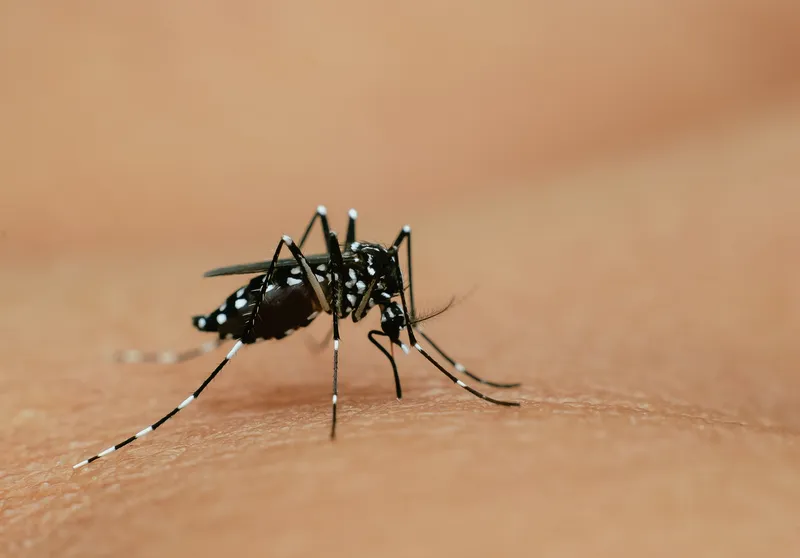
Asian tiger mosquito (Aedes albopictus) image from UKHSA blog.
Overview
Aedes albopictus is an invasive mosquito species known for daytime biting and its adaptability to urban container habitats.
It is also known as the tiger mosquito because of its black-and-white banding. It is important for public health; it has been linked to outbreaks of dengue and Zika in parts of Europe.
This species is easily confused with Aedes aegypti. The quickest way to tell them apart is the thorax: Ae. albopictus has a single straight white stripe down the middle, while Ae. aegypti has a curved, lyre-shaped pattern. If you're unsure, take a clear photo and report it to the UKHSA.
UK Relevance
The UK currently focuses on early detection and prevention of establishment. Public health risk remains low, but surveillance and reporting is prioritised for this species because it can spread quickly once established and can carry several pathogens.
UK surveillance first detected Ae. albopictus eggs in Kent in 2016, with further detections between 2017 and 2019. After several years without detection, eggs were detected again in August 2024 at a service area on the M20 in Kent. Follow-up surveillance did not find evidence of an established local population, but it is obvious that intorductions are still occurring, increasing the risk of establishemnt.
Identification
- Look for a small black mosquito (about 7 to 8 mm) with one clear white line down the middle of the thorax.
- Legs are banded with white scales (usually quite obvious), and wings are plain (not spotted).
- It is often confused with native species such as Culiseta annulata and Aedes geniculatus, so clear photos are very helpful for confirmation.
Habitat and Season
This mosquito lays eggs in small water containers such as plant saucers, buckets, tyres, and neglected garden items. In the UK, that makes it a species of concern for ports, lorry parks, service stations, transport hubs, and other high-traffic entry points where mosquitoes may hitchhike in vehicles along transit and trade routes.
UKHSA's surveillance programme uses ovitraps (where the female lays their eggs) at these likely entry points, with intensified work in parts of South East England where climate models suggest conditions are becoming more suitable.
Diseases
Globally, Aedes albopictus is linked to transmission of dengue, chikungunya and Zika. In Europe, this species has already been implicated in local outbreaks, which is why UK surveillance treats incursions seriously even when overall UK risk remains low.
What to Look For
If you think you have seen an Asian tiger mosquito, take a clear photo, note the exact location, and include habitat details if you can (for example tyres, buckets, drains, or other water-holding containers).
You can report sightings through GOV.UK mosquito reporting guidance.
References & Further Reading
- Geddes, L. (2025) — Dengue-carrying mosquitoes have been detected in the UK: should you be worried?
- UK Health Security Agency (2025) — Distinguishing Aedes albopictus, the Asian Tiger mosquito, from native British mosquitoes
- Medlock et al. (2017) — Detection of the invasive mosquito species Aedes albopictus in southern England
- Blog Editor, UKHSA (2024) — How you can help us resist the tiger mosquito's conquest of Europe