How to Prevent Tick Bites
You don’t need to avoid the outdoors altogether in order to protect yourself from ticks! A few simple steps can dramatically reduce your risk of getting bitten. Below is a compilation of recommendations from the NHS, UKHSA, Lyme Disease Action, and other research and health organisations.
Before You Go Out
- Cover up! Wear long trousers tucked into socks, long sleeves, and closed-toe shoes when walking through long grass, woodland, or heathland.
- Stick to paths. Ticks wait on vegetation tips to latch on as you brush past. Walking on marked paths reduces contact (and preserves our wild areas as a bonus!).
- Use insect repellent. Apply a DEET-based repellent (20–50%) to exposed skin and clothing. Products containing permethrin can be applied to clothing and gear for longer-lasting protection, but are not to be applied directly to skin. Natural repellant options tend to be significantly less effective.
- Wear light-coloured clothing. This makes it easier to spot ticks crawling on you before they have a chance to attach (the same logic used for tick surveys).

After You Come Inside
- Check your whole body. Ticks are tiny! Nymphs are about the size of a poppy seed. Pay special attention to the hairline, behind the ears, armpits, waistband, groin, and behind the knees.
- Don't forget to check children and pets. Run your hands over skin and fur, feeling for small new bumps.
- Shower within two hours of coming indoors. This can wash off unattached ticks and gives you another chance to spot them. This is the perfect time to conduct a full-body tick check.
- Tumble-dry clothes on high heat for 10 minutes to kill any ticks that may have hitched a ride. Washing alone does not reliably kill them. If you don't have access to a dryer, wash on high heat and put in the sun to dry, preforming a visual inspection for any hangers-on.
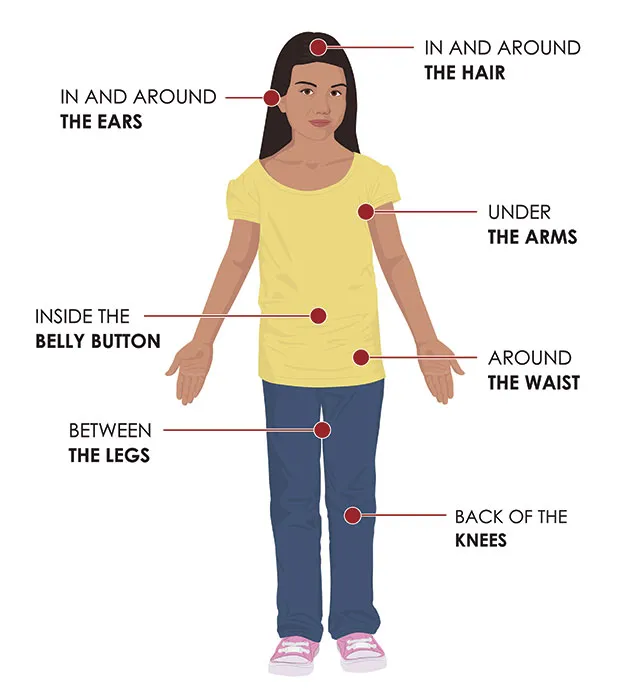
Diagram: where to check your body for ticks (source: CDC).
Protecting Pets
- Ask your vet about options for tick preventive treatments. These may include topical solutions, collars, or edible tablets for dogs and cats.
- Check pets after every walk, especially around the ears, eyes, muzzle, legs, belly, and between their toes. Pay special attention to pets with long, fine fur, as this often obscures tick presence.
- Remove any attached ticks promptly using a tick removal tool or set of tweezers .
Perform a Tick Check
This short video is useful for learning how to spot ticks on yourself of a loved one. Note that Ixodes scapularis is a Lyme-carrying North American relative of Ixodes ricinus and Ixodes hexagonus. It is not found in the UK.

Found a Tick?
Don’t panic! Remove it as soon as possible using a fine-tipped tick tool or tweezers. The sooner a tick is removed, the lower the chance it transmitting infection to you. Monitor the bite area for up to 4 weeks. See your GP if you develop a rash or feel unwell after a bite. Read more on our Lyme disease page.