Castor Bean Tick / Sheep Tick
Overview
Ixodes ricinus is the most common and most medically important tick in the UK. It bites humans, livestock, pets, birds, and wild mammals. It is the main vector for Lyme disease and can also transmits several other pathogens.
You may see it called the "castor bean tick" (the engorged female resembles a castor bean) or the "sheep tick" (as it is frequently found on sheep and deer).
Identification
- Adults: ~3–4 mm when unfed. Females have a dark-brown scutum (shield) on the front third of the body, with a pale grey abdomen that swells dramatically when engorged (up to ~11 mm). Males are smaller and entirely covered by a dark scutum.
- Nymphs: ~1–2 mm, about the size of a poppy seed. Pale brown, eight legs. This is the stage most likely to bite humans as they seek out the blood meal needed to grow into adults.
- Larvae: < 1 mm, six legs, very difficult to see with the naked eye.
Distribution in the UK
Found across all parts of the UK, particularly in woodland, heathland, moorland, rough pasture, and areas with bracken or long grass. Populations are densest in western and northern regions (Scotland, Wales, south-west England) where humidity is higher, but this species has been expanding its range and is now recorded in urban parks, gardens, and coastal paths.
Use our dashboard to check GBIF occurrence records near your postcode.
UK Occurrence Records
Loading map…
Life Cycle & Behaviour
The full life cycle (egg → larva → nymph → adult) takes about 3 years on average, and can take longer where hosts are scarce. Each active stage needs a blood meal from a different host before moulting to the next stage, so the timing depends on how quickly each stage finds one.
Ticks “quest” by climbing onto low vegetation and waiting with outstretched front legs for a passing host to brush by. They are most active in damp and warm conditions, typically March–October. Questing activity usually gets going once temperatures start to increase and humidity is high. See tick ecology for more information.
Larvae and nymphs feed heavily on small mammals and ground-feeding birds, and birds are how this species covers ground: a tick that attaches to a migrating bird can be carried far beyond anywhere it could walk. See what ticks feed on for a photograph of an engorged tick on a wren.
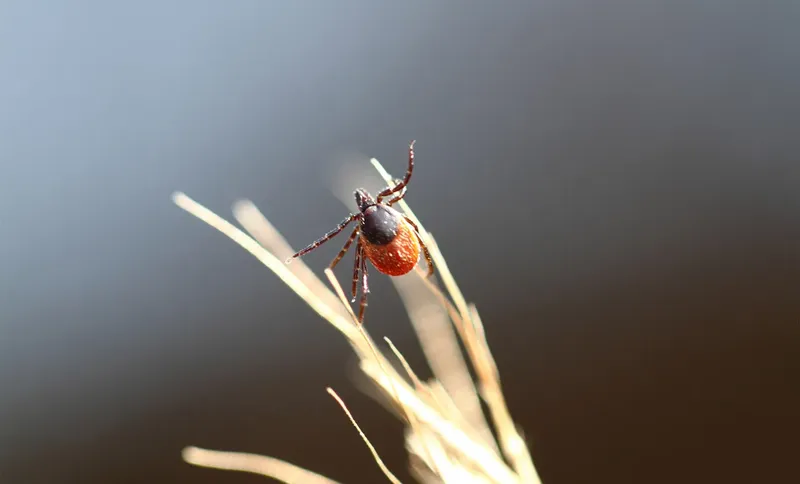
Questing behaviour of Ixodes ricinus on vegetation (source: ECDC).
Diseases & Public Health
Ixodes ricinus is the UK’s primary vector for:
- Lyme disease (Borrelia burgdorferi sensu lato), the most common tick-borne infection in the UK, with around 1,000 laboratory-confirmed cases reported annually in England and Wales (the true number of infections is likely higher due to under-reporting).
- Anaplasmosis (Anaplasma phagocytophilum) — uncommon in humans but circulates in livestock and wildlife.
- Babesiosis (Babesia spp.) — very rare in UK humans.
- Tick-borne encephalitis (TBEV), the virus has been detected in ticks in parts of England; confirmed human cases remain extremely rare.
- Rickettsial infections — Rickettsia helvetica and others detected in UK ticks.
- Borrelia miyamotoi, a relapsing-fever spirochete found in Ixodes ticks across Europe.
Prevention & Advice
- Follow our bite prevention guide when visiting tick habitats.
- Check your body (and pets) after outdoor activity... remove ticks promptly.
- Monitor the bite site for up to 4 weeks. See your GP if a rash or flu-like symptoms develop — early treatment for Lyme disease is highly effective.