The That Bites! Project Surveys
Read on to hear about our first pilot survey on the University of Warwick campus, what we found, and why it matters.
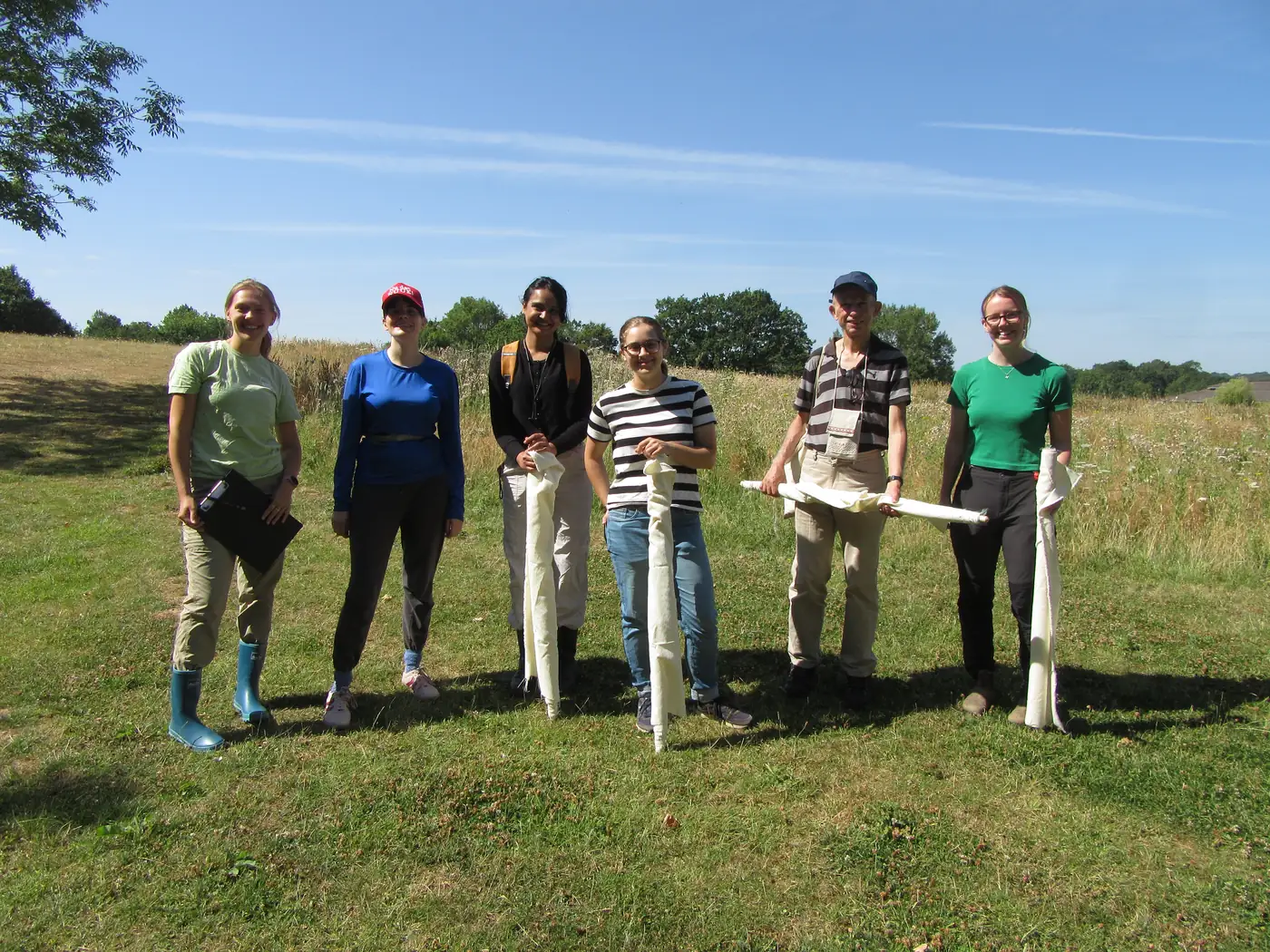
So…how DO we look for ticks?
Ticks quest: they climb a grass stem or a leaf, hold their front legs out in the air, and wait for something to brush past. Looking for ticks means channelling your inner wild mammal.
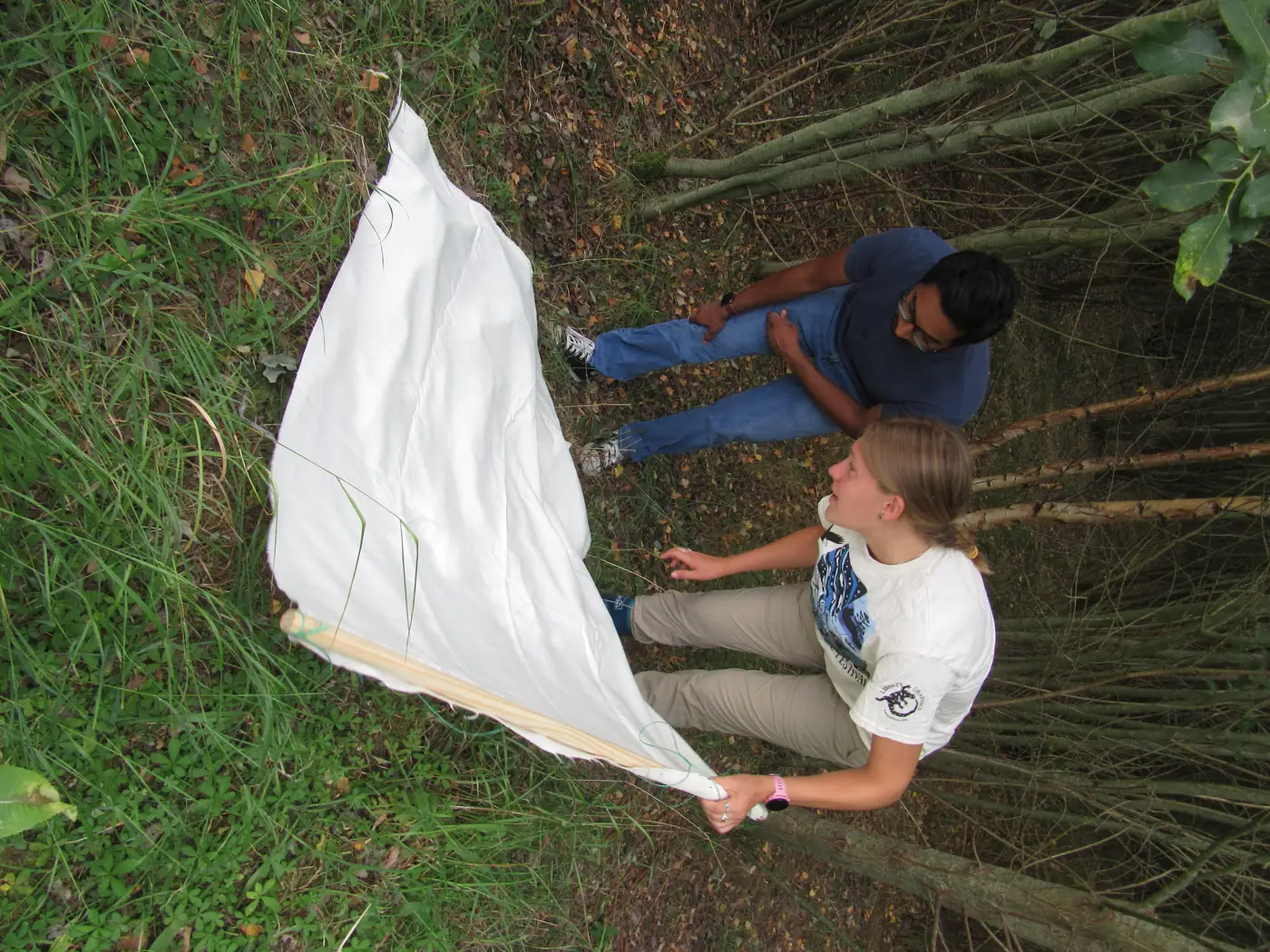
The tool we use is a drag cloth: a square of pale, heavy cotton (we use a courderoy), roughly a metre by a metre, with a wooden dowel through the top hem. A rope runs from the dowel to the person walking. The idea is that questing ticks will grab the cloth as it passes. The pale fabric makes them easy to spot along the way.
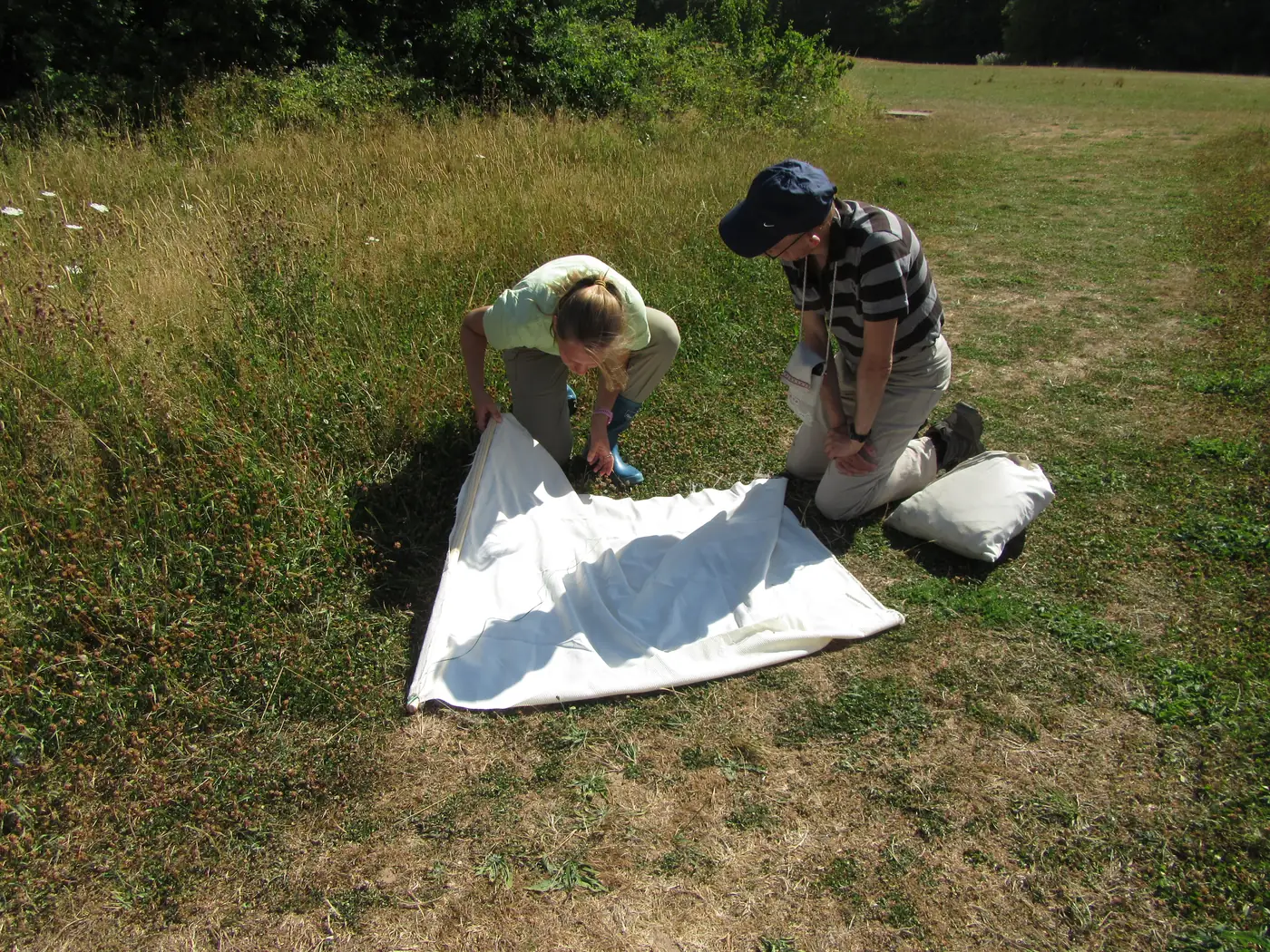
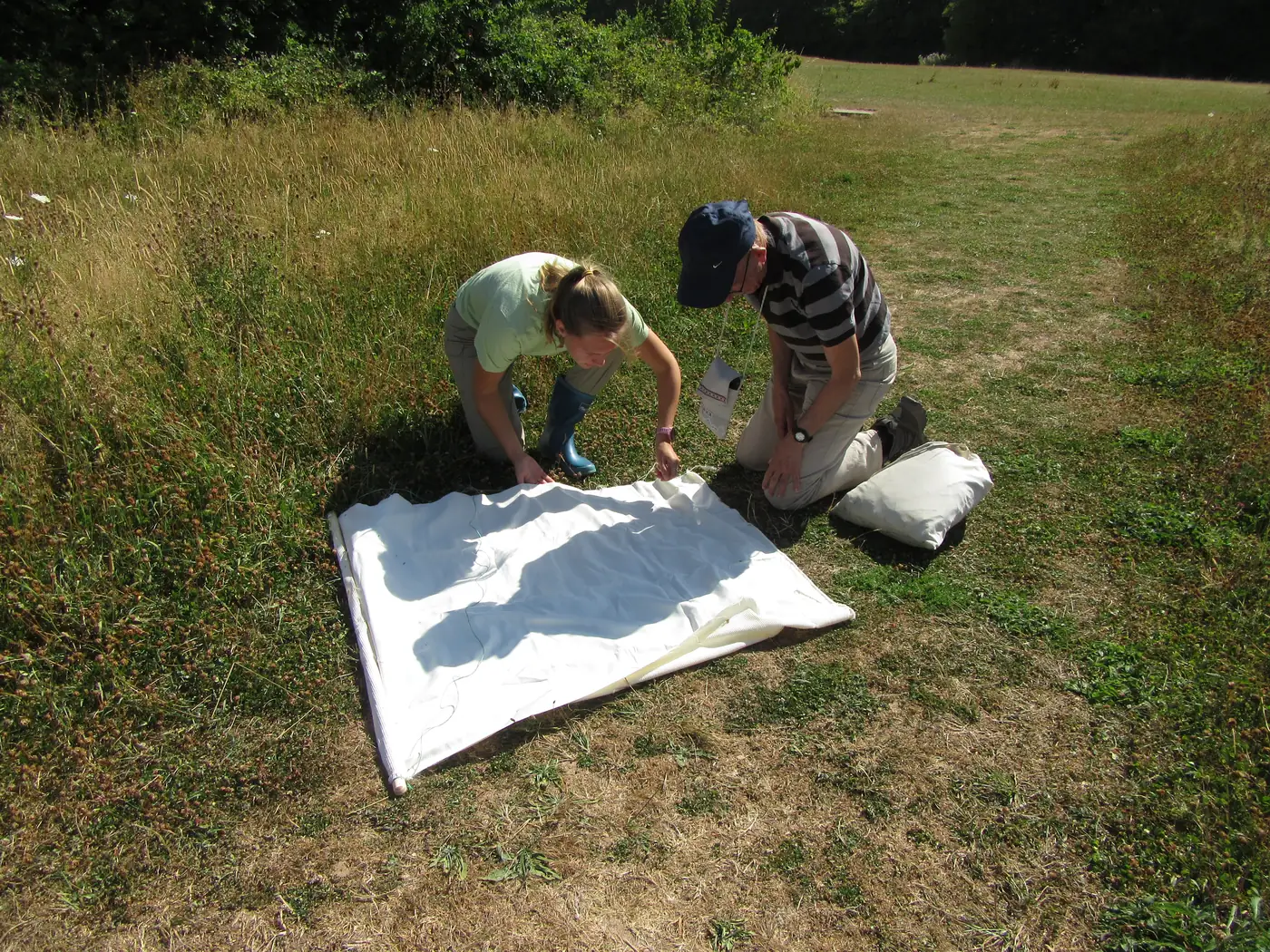
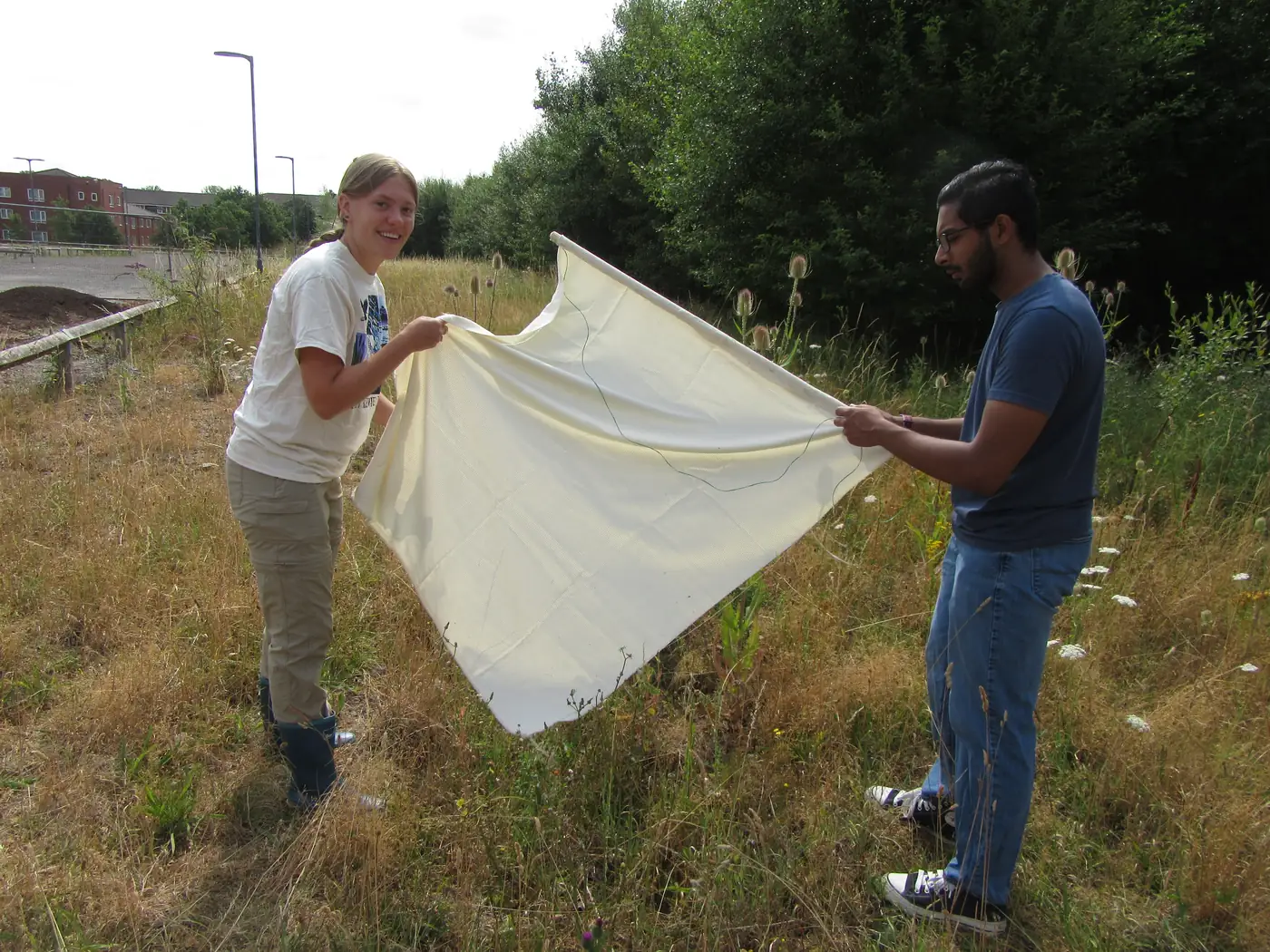
There are two related methods, and they are not quite the same thing (though they do get confused). Dragging trails the cloth behind you along a measured line (our technique). That can then be turned into a density measurement, if you record the area you covered. Flagging sweeps a similar cloth on a pole across the vegetation, which suits dense or uneven ground but does not give you a clean area.
Either way, a session runs like this:
- Lay the cloth flat Start at the beginning of the transect with the cloth in full contact with the vegetation or leaf litter.
- Walk slowly and straight The standard pace is about 50 metres per minute, a deliberate walk, not a stroll and not a march. Keep the line as straight as the ground allows.
- Stop and check every 15 metres Turn the cloth over and look carefully, on both sides. Ticks can be very small, so this is the most time-consuming part.
- Lift any ticks with fine forceps Each one goes into a labelled tube recording site, date, time and collector. These can be used for identification and proper storage later.
- Record the conditions Date and time, habitat, how the site is managed, vegetation type, ground conditions, temperature, humidity, and even the wind speed are also recorded. All of this helps with downstream understanding of what is found.
Published guidance recommends covering at least 750 m² per site and reporting results as ticks per 100 m² rather than as a raw count. This way, surveys done by different people in different places can be compared.
Why does the weather impact results so much?
Questing ticks are extremely exposed; they lose water the whole time they sit on out on grass stems. To rehydrate, they have to climb back down into the damp mat at the base of the plant. How fast they dry out depends on how much water seeps into the air, a quantity called the saturation deficit, which combines temperature and humidity into one number.
A low deficit means damp, comfortable air for ticks, making them happy to sit out and wait for a tasty meal to come by. A high deficit means dry air; ticks stay down close to the ground to wait it out instead. For Ixodes ricinus, for example, a comfortable questing defecit corresponds to roughly 2–3 mmHg.
Therefore...
You cannot survey when the vegetation is soaking wet (wet cloths don't work at all), and surveys when it is bone dry are not productive. See below for an example from our survey: zero ticks found, but not necessarily because they weren't there.
Our pilot tick survey
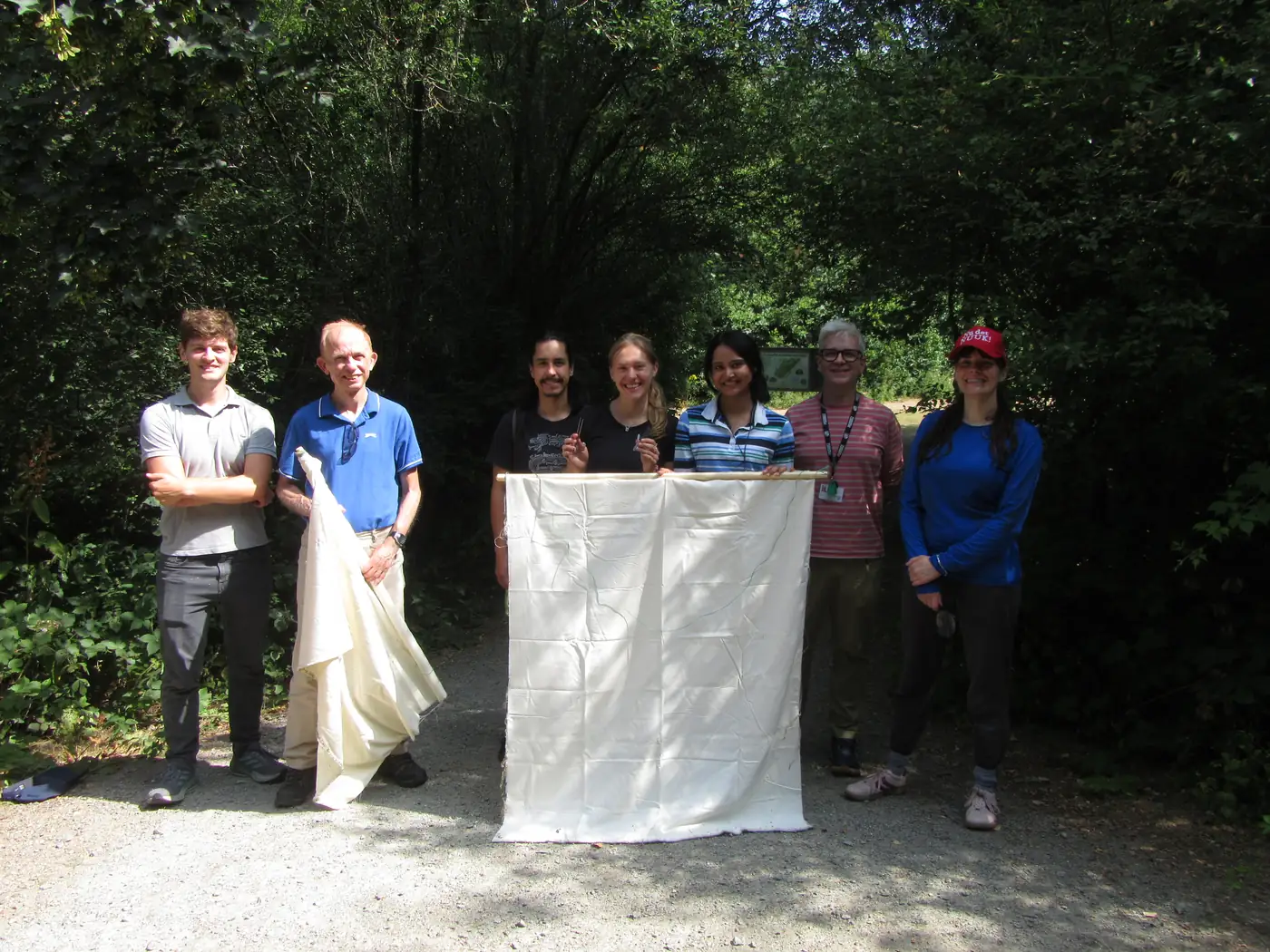
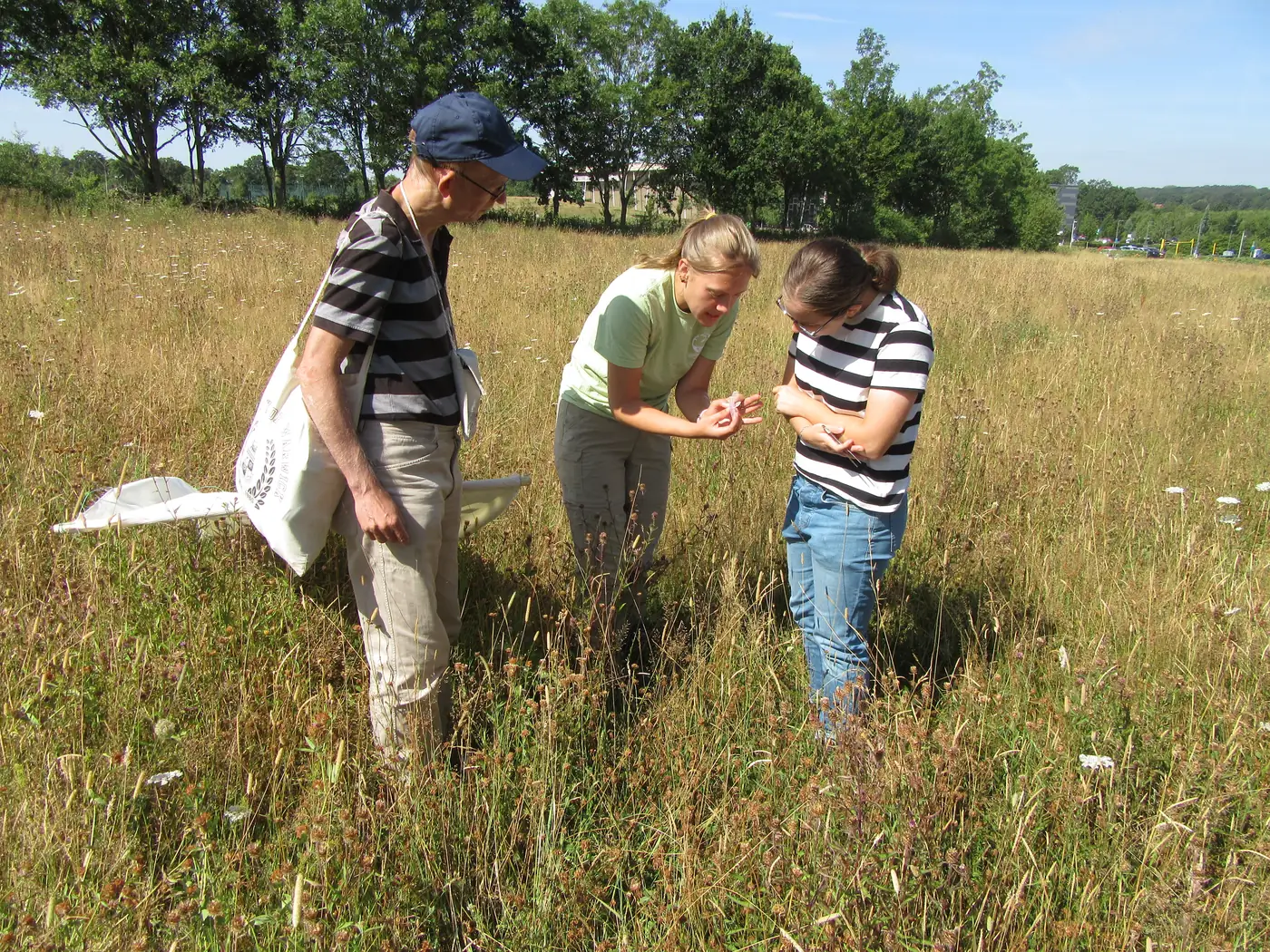
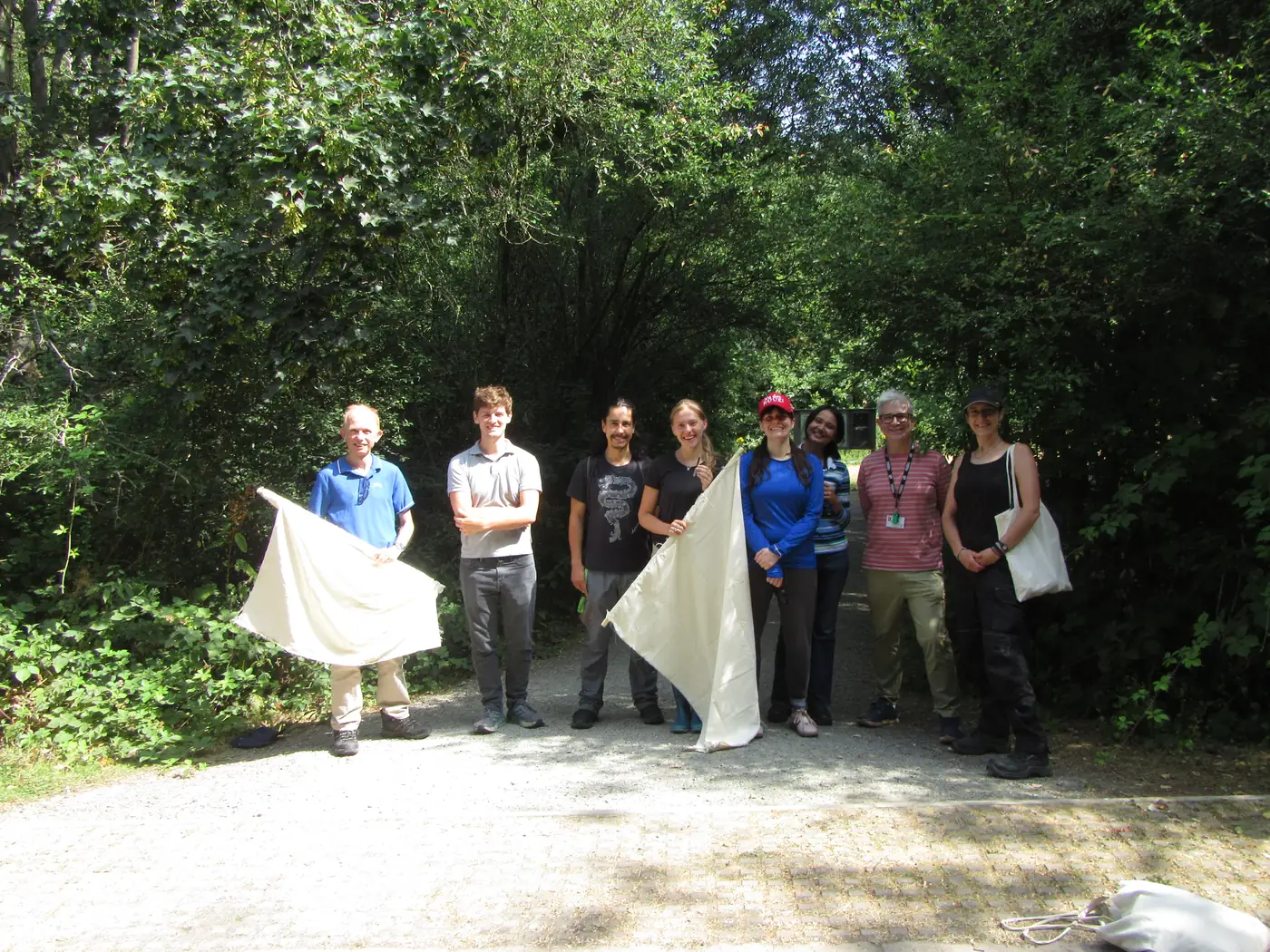
Surveys were run in conjunction with the campus Biodiversity Action Team. We chose three sites on campus to contrast habitat and management: an open field with a mown edge and meadow planting, an unmanaged field and woodland edge, and mature woodland. Each was surveyed once, for about an hour, with four drags per session thanks to our amazing volunteer teams.
| Date | Site | Management | Habitat | Air temp. | Humidity | Sat. deficit | Ticks |
|---|---|---|---|---|---|---|---|
| Mon 20 Jul | Dinosaur Field | Managed | Open field and edge, amenity grass and meadow | 20 °C | 60% | 6.85 mmHg | 0 |
| Tue 21 Jul | Sherbourne Residences | Unmanaged | Field and edge | 19 °C | 57% | 6.92 mmHg | 0 |
| Thu 23 Jul | Gibbet Hill Wood | Woodland | Woodland and understorey | 18 °C | 59% | 6.20 mmHg | 0 |
All three sessions were very dry, sunny and nearly windless, and all three returned the same number of ticks: NONE.
What we found, and what it DOES NOT mean
Zero ticks is NOT the same as no ticks
Three sessions returning nothing is a real result. However, on its own it cannot support the conclusion that these sites are tick-free. Why? Read on.
There are good reasons to think questing was suppressed rather than absent:
- The West Midlands were in a dry spell. July rainfall was around 3% of the expected amount for the month. The following week, a drought was officially declared for the region.
- The air was far too dry. We measured 6.2–6.9 mmHg saturation deficit, over twice what suits I. ricinus. The grass was crispy and the forest floor mat layer thin and dry, with dusty ground beneath.
- We surveyed in the midsummer trough, between the spring and autumn nymphal activity peaks. We knew this was a risk, and plan to survey again in September when we expect nymphal activity to be increased.
We also noticed that the surveyed sites had tick-haven characteristics:
- Hosts were abundant at every site: small mammals, birds, rabbits, and sign of fox, deer and even badger. Ticks need hosts, and the hosts are plainly there in abundance.
- Ticks have been recorded in the area through historical veterinary surveys and sightings (see CV4 7AL on the home page).
Therefore...
it is very possible that the ticks were there but were not actively questing. It’s also possible that there truly are no ticks. Either way, we cannot know this for sure without further surveys.
What we are changing next
The pilot did its job; we now know our method works in practice. Now we plan to survey when conditions are more favourable for questing behaviour (specifically, when there has been more rainfall, there is more moisture in the air, and tick activity may be higher in general due to the season).
| Change | How it should improve the survey |
|---|---|
| Repeat in September | Sample the autumn nymphal peak. If we still find nothing, absence becomes a more serious possibility. |
| Move to more humid days/times of day | Survey when the saturation deficit is lowest and ticks are most likely to be questing. |
| Log microclimate at ground level each session | Turns “it was dry” into a number we can compare between sites and sessions. Provides more robust data. |
| Fix and georeference our transects, and record area covered | Makes sessions repeatable year on year and lets any future finds be expressed as ticks per 100 m². |
Check back in September for updates from our next survey!
Sources
- Salomon, J., Hamer, S. A., & Swei, A. (2020). A beginner’s guide to collecting questing hard ticks (Acari: Ixodidae): a standardized tick dragging protocol. Journal of Insect Science, 20(6), 11. doi:10.1093/jisesa/ieaa073. Source of the drag cloth dimensions, the 50 m/min pace, the 15 m checking interval, and the 750 m² / ticks-per-100 m² reporting standard used above.
- Randolph, S. E., & Storey, K. (1999). Impact of microclimate on immature tick–rodent host interactions (Acari: Ixodidae): implications for parasite transmission. Journal of Medical Entomology, 36(6), 741–748. doi:10.1093/jmedent/36.6.741. Source of the saturation deficit calculation used in our field records.
- Hansford, K. M., McGinley, L., Wilkinson, S., et al. (2021). Ixodes ricinus and Borrelia burgdorferi sensu lato in the Royal Parks of London, UK. Experimental and Applied Acarology, 84(3), 593–606. doi:10.1007/s10493-021-00633-3. Ticks were found in only two of nine London parks surveyed, useful context for a survey that found none.
- Nelson, C., Banks, S., Jeffries, C. L., Walker, T., & Logan, J. G. (2015). Tick abundances in South London parks and the potential risk for Lyme borreliosis to the general public. Medical and Veterinary Entomology, 29(4), 448–452. doi:10.1111/mve.12137.
- UK Health Security Agency. Tick Surveillance Scheme, GOV.UK.