Yellow Fever Mosquito
Mosquito Watch: recently found breeding in east London, September 2026
On 3 September, 2026 the UK Health Security Agency (UKHSA) announced that Aedes aegypti adults and larvae had been found at residential properties in east London. This is the first time this species has been recorded breeding in the UK. The UKHSA currently assesses the risk to the public as very low, and control work is already underway at the site. The finding came in through Mosquito Watch, the public reporting scheme, so citizen science actively contributed to this discovery!
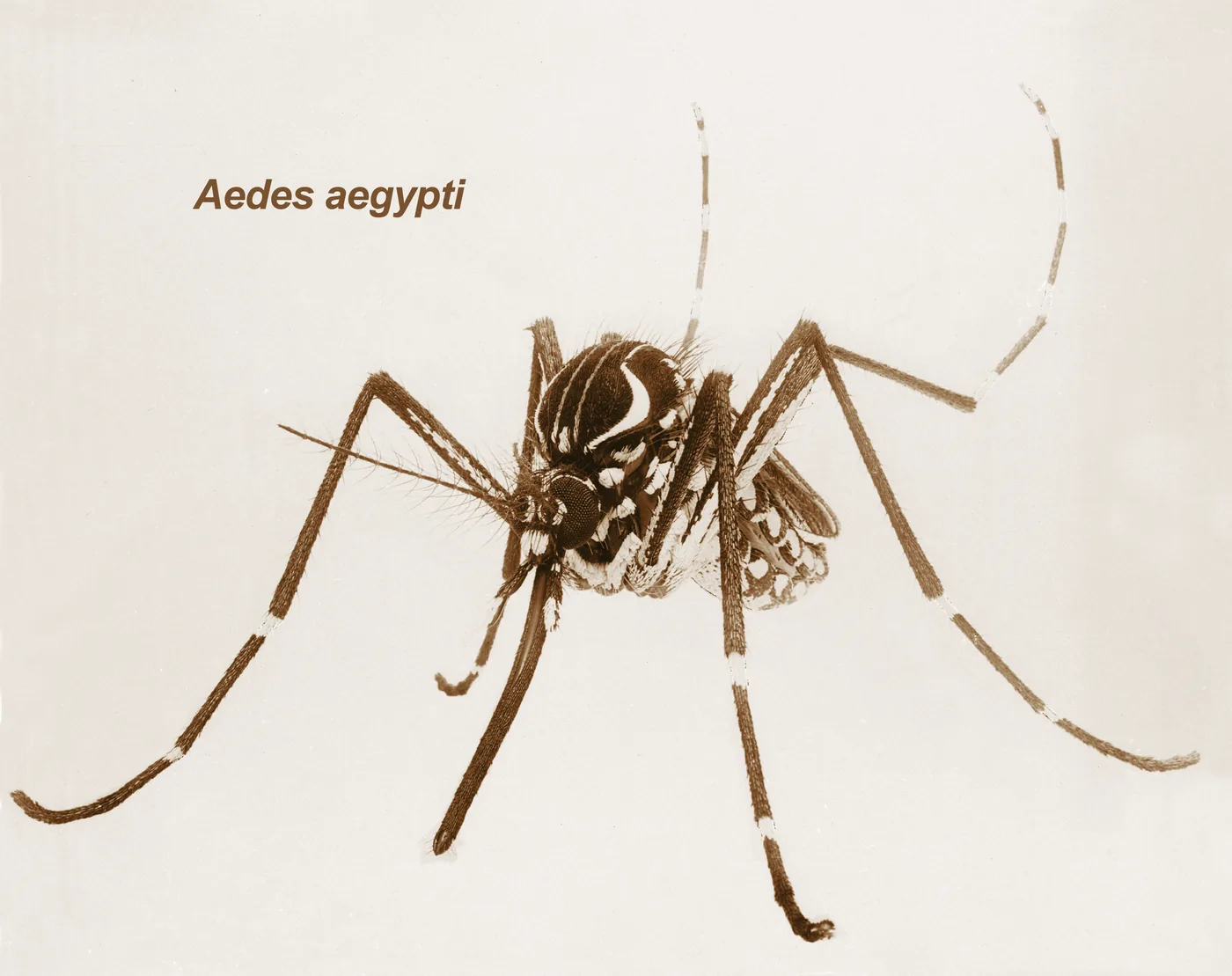
Adult Aedes aegypti. Public domain, CDC Public Health Image Library.
Overview
Aedes aegypti is the mosquito most closely associated with human settlements around the world in tropical and subtropical regions. It breeds in small water-filled containers around human settlements, bites during the day (not at night, dusk, or dawn like other species), and often rests and feeds indoors. This habit and life history of living alongside and aggressively feeding on people is what makes it such an efficient carrier of disease and public health risk in many parts of the world.
It is a different species from the Asian tiger mosquito, though the two look broadly similar and share similar container habitat preferences.
NEW: UK Relevance
The discovery of Aedes aegypti in September 2026 in east London was the fourth detection of Aedes aegypti in the UK in recent years, however, it was the first where breeding was confirmed. The UKHSA found both adult mosquitoes and larvae at residential properties. They have now treated the site to destroy the larvae, and are continuing to monitor the area for any further mosquitoes.
We should be careful to note that breeding is NOT the same as establishment. The UKHSA and independent entomologists both expect the UK climate to remain a barrier for this species: this is a tropical mosquito that has historically struggled to survive British winters, and unlike the Asian tiger mosquito, its eggs are not notably cold tolerant. Mosquitoes present in the summer are not expected to survive autumn and winter outdoors. However, the finding is a reminder and warning that the risk of disease circulation in the summer months in the UK may increase in the future.
The mosquitoes are believed to have arrived accidentally. Invasive Aedes species are sneaky; they can hitch-hike in vehicles, baggage, and even in things like cut flowers and imported plants. This means that repeat introductions are likely to continue happening at ports, airports, and areas with international movement.
Why is the risk still described as very low?
The risk to the public is low because the viruses this mosquito can carry are not circulating in the UK. A mosquito only becomes a health risk if it bites someone (or something) which is already infected, and then bites someone else. The UKHSA reported no evidence of human infections from this finding, and no mosquitoes or larvae have been found in nearby public areas.
Identification
- A small, dark mosquito, roughly 4 to 7 mm in length, with striking white markings.
- The clearest feature is on the top of the thorax: a pair of curved white lines down the sides with two straight lines between them, often described by entomologists as lyre-shaped, like the outline of a small harp.
- Legs are boldly banded black and white, and the last segment of the hind leg is usually all white.
- The Asian tiger mosquito is the main look-alike. It has a single straight white stripe down the middle of the thorax rather than the distinctive lyre pattern.
The photograph at the top of this page shows both features clearly: the lyre marking on the thorax and the banded legs. Several harmless native species also have pale leg banding, so a clear photo is worth more than a confident guess. UKHSA identifies submitted specimens for you.
Habitat and Season
This is a container breeding mosquito, and the containers it prefers are the ones we most often leave lying around: buckets, plant pot saucers, paddling pools, watering cans, blocked drains, uncovered water butts, tyres, and bins. It rarely needs more than a few centimetres of standing water in order to lay and hatch eggs.
The mosquito bites mainly in daylight, with peaks in the morning and late afternoon, which is the opposite of the typical dusk-and-dawn pattern people expect from UK mosquitoes. It is also happy to rest indoors, so bites can happen inside the house where you might otherwise expect to be safe.
Diseases
Worldwide, Aedes aegypti is the principal vector of dengue, chikungunya, Zika and yellow fever. The risk of these diseases in the UK is very low, but travellers should be aware of the risk in countries they may visit.
What You Can Do
The single most useful thing is to get rid of standing water around your home. The UKHSA has requested east London residents to do exactly this, and it is good practice anywhere in the UK because it also cuts down nuisance biting from native species.
The next useful thing you can do is to report if you think you have seen an unusual mosquito. Take a clear photo, note the exact location and the habitat, and report it to the UKHSA. The recent detection reached the UKHSA because a member of the public submitted a report, so your report can go a long way towards protecting yourself and others!
See how to report a mosquito, or go straight to Mosquito Watch on GOV.UK. For bite prevention, see preventing mosquito bites.
References & Further Reading
- UK Health Security Agency (2026) — Invasive mosquito species detected in east London
- UKHSA Blog (2026) — Should I be concerned that an invasive mosquito species has been detected in east London?
- Science Media Centre (2026) — Expert reaction to the detection of Aedes aegypti in east London
- UK Health Security Agency (2025) — Distinguishing invasive Aedes mosquitoes from native British mosquitoes
- UK Health Security Agency (2026) — National contingency plan for invasive Aedes mosquitoes in England
- UK Health Security Agency — Invasive mosquito surveillance